
Selecting the correct reciprocating saw blade size is essential for safe and efficient cutting, especially for homeowners, DIYers, and professionals working with various materials. To determine the right size, begin by measuring the thickness of the material you plan to cut.
Choose a blade that is 2–3 inches longer than the material’s thickness to ensure proper clearance and optimal performance. Using a blade that is too short may lead to wobbling or binding, which can compromise safety and cause damage to your tool or workpiece.
Conversely, selecting a blade that is too long might result in difficulty controlling the cut or unnecessary stress on the saw. Keep in mind the type of cut required: shorter blades are ideal for precision tasks, such as detailed or narrow cuts, while longer blades are better suited for deep or demolition cuts through thick materials.
Proper sizing not only enhances your cutting accuracy but also reduces the risk of accidents, making your project safer and more successful. Learning how to match blade length to your specific work ensures better results and greater confidence with your reciprocating saw.
Why Blade Size Makes a Difference in Your Reciprocating Saw Projects
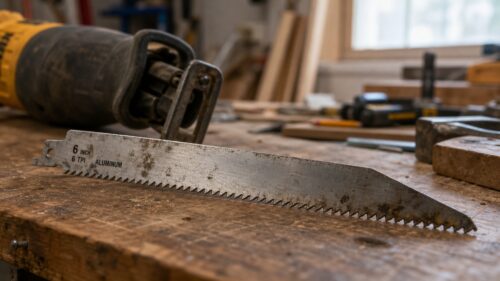
When choosing a reciprocating saw blade, you must consider the size for the best results. The blade size impacts cutting performance, especially through material thickness. Find a blade 2–3 inches longer than the material to prevent slipping and guarantee clean, safe cuts. Smaller blades give more control and precision, ideal for tight spots and small projects. Longer blades work better for demolition or pruning large trees, allowing faster progress. Always match the blade size with your project needs to reduce vibration and wear. Correct sizing improves safety and efficiency, giving you better control and more precise cuts in any task. Additionally, selecting the right-sized blade can help reduce vibration and wear, minimizing fatigue during extended use.
Understanding Common Blade Lengths and When to Use Them
To choose the right reciprocating saw blade length, start by measuring the material thickness. The blade length should be 2-3 inches longer than the material’s thickness to guarantee safe, effective cutting. Shorter blades (3-6 inches) provide precision in tight spaces or detail work. Medium blades (6-9 inches) suit general-purpose tasks or medium-depth cuts. Longer blades (9-12 inches) are best for deep cuts or large materials like wood. When selecting, consider the cutting depth you need. Choosing a blade with an appropriate power and efficiency is essential for optimizing performance and achieving clean cuts. For tight, detailed cuts, use shorter blades. For larger, deeper cuts, opt for longer blades.
How to Choose the Right Blade Length for Your Material’s Thickness
Measuring the thickness of the material is the first step in choosing the right blade length. Do this accurately so you prevent binding or wobbling during cuts. For a reciprocating saw, guarantee the blade length is at least 2-3 inches longer than your material’s thickness.
- Use a shorter blade, 3-6 inches, for precision or tight spots.
- Choose a longer blade, 9-12 inches, for deep or large cuts.
Select a blade 2 inches longer than your maximum material thickness to optimize cut accuracy and control. Avoid blades that are too long, or else you risk wobbling, uneven cuts, and accelerated wear.
Additionally, consider the blade length to ensure compatibility with your saw and specific project needs.
What’s the Difference Between Blade Length and Cutting Depth?
Understanding the difference between blade length and cutting depth is essential for safe and effective cutting. You must recognize that blade length is the entire blade’s measure, while cutting depth is the maximum thickness it can cut. Use longer blades, typically 2-3 inches longer than the material, so you avoid binding or wobbling. Shorter blades are for precise cuts, while longer blades are for deeper cuts. Study blade design to match it with your task.
- Keep blade length longer than material.
- Match cutting depth to blade’s maximum.
- Prevent wobble by choosing right size.
- Use shorter blades for accuracy.
- Select longer blades for larger materials.
- Be aware of reciprocating saw cutting depth limits to ensure safe operation and maintain blade integrity.
How Blade Width and Thickness Affect Your Cutting Performance
Match the blade width and thickness to your cutting needs. Use wider blades (3/4 to 1 inch) for heavy-duty work, providing stability and resisting bending. Narrower blades (1/2 to 3/4 inch) are better for precise, detailed cuts in tight spots. Thicker blades (0.050 inch or more) are stronger, ideal for dense materials, and resist breakage. Thinner blades (around 0.035 inch) cut faster and smoother but aren’t suitable for tough materials. Adjust your choice based on the material being cut, as blade width and thickness directly impact cutting performance, speed, and durability. Incorporating blades with high-speed-steel teeth and a flexible backing steel can enhance cut quality and longevity, especially when dealing with demanding tasks.
Why Thinner Blades Cut Faster and When to Use Thicker Blades
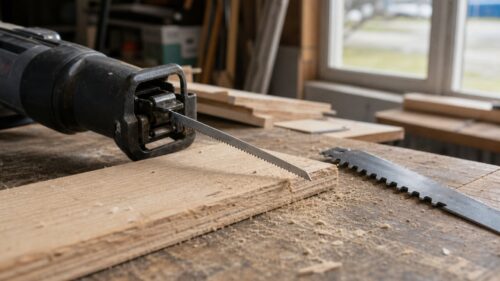
When selecting a reciprocating saw blade, consider why thinner blades, about 0.035 inches thick, cut faster than thicker ones. Thinner blades produce less resistance, so they have a higher cutting speed. Use them for light tasks like trimming pipes or thin metal. Thicker blades, 0.050 inches or more, are stronger and better for dense materials like hardwood or thick metal.
- Choose thinner blades for speed and light-duty work.
- Pick thicker blades when working with dense or tough materials.
- Use thinner blades to avoid bending or breaking.
- Opt for thicker blades for safety in heavy cuts.
- Match blade thickness to material density for best results.
Should You Use Shorter or Longer Blades for Your Job?
Select the appropriate blade length based on your project needs. Use shorter blades, around 4-6 inches, for better control and precision in tight spaces or detailed cuts, so you achieve cleaner results. Choose longer blades, 9-12 inches, to make faster, deeper cuts in large materials or during demolition, or until speed is more critical. Confirm the blade is at least 2-3 inches longer than the material thickness to maintain stability and cut quality. Longer blades that extend too far can wobble and reduce cut quality, so avoid overextending. Always match your blade length to the material size for maximum results. To ensure clean drywall cuts, selecting the right blade length helps maintain control and achieves smooth, precise results.
How to Match Your Blade Size to Material Density and Thickness
To choose the right reciprocating saw blade, measure the material thickness first. Select a blade size 2-3 inches longer than the material’s thickness to prevent wobbling and boost cutting efficiency. Use longer blades (9-12 inches) for thick, dense materials, or else you’ll struggle with stability. For thin or tight cuts, opt for shorter blades (3-6 inches) to improve control. Confirm the blade’s thickness (0.050 inches or more) matches the material’s density, or else you risk bending or breaking.
- Use longer blades for heavy-duty work.
- Choose shorter blades for precision.
How Blade Length Influences Access in Tight Spaces
Use a shorter saw blade, 4 to 6 inches long, to access tight spaces effectively. Select this size to improve maneuverability, so you can bend and turn the blade easily in confined areas. Short blades reduce wobbling and vibration, giving you better cutting control. Longer blades, 9 to 12 inches, are harder to navigate in restricted spaces and limit precision. Confirm the blade length matches the material’s thickness, typically 2-3 inches longer, to prevent binding.
- For very tight spaces, use the shortest blade possible.
- Longer blades are suitable for open, broader cuts.
How to Ensure Your Blade Size Fits Your Reciprocating Saw Model
Before selecting a blade, verify your reciprocating saw’s compatibility by checking its specifications. Confirm the blade size, length, and shank type, or else the blade may not fit or cut effectively.
- Check the saw’s manual for maximum and minimum blade lengths, so you avoid using blades that are too long or short.
- Measure your current blade or cutting needs to match the blade length with your project, or else you risk inefficiency.
- Identify the clamp type to ensure compatibility, as keyed or quick-attach systems only accept certain blades.
- Compare shank types; standard or universal shanks must match for safe fit to your reciprocating saw.
Signs You Need a Different Blade Size for Better Results
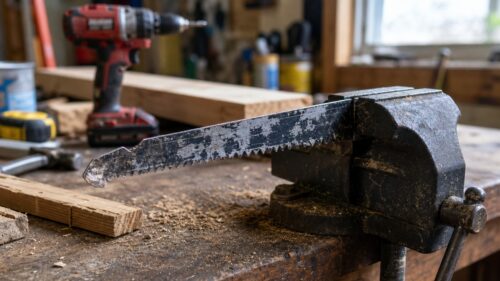
If you find yourself struggling to control the reciprocating saw or notice incomplete cuts, it is a sign you need a different blade size. Wobbling, excessive strain, or slow progress indicate the current blade isn’t fitting the material properly. Use a blade at least 2-3 inches longer than the material’s thickness for peak performance. If the blade bends, breaks, or you feel increased vibration, change to a size suited to the job.
| Problem | Cause |
|---|---|
| Wobbling or wobbling noise | Blade too short or too long for material |
| Incomplete cuts | Blade size mismatch |
| Excessive strain | Blade is too tight or too loose |
| Vibration or bending | Incorrect blade length or worn blade |
Tips for Handling and Maintaining Blades of Various Sizes
Proper handling and maintenance of reciprocating saw blades of various sizes are essential for safety and peak performance. You must select the right blade size for the material and task. Keep blades sharp, clean, and free of damage to avoid accidents and ensure efficient cuts. Store blades properly, away from moisture to prevent rust. When cutting, choose the appropriate blade length, 2 to 3 inches longer than the material thickness. Regularly inspect blades for missing teeth or dullness, replacing them immediately. Use shorter blades (4-6 inches) for precision, and thicker blades for denser materials. Follow these guidelines to extend your blade’s lifespan and improve your cutting results.
- Keep blades clean and dry after use.
- Use the correct blade size for each task.
- Replace blades showing damage or dullness.
- Store blades in a dry, organized space.
- Handle blades carefully to avoid injury.
Picking the Perfect Blade Size for Safe, Efficient Cutting
Selecting the correct reciprocating saw blade size is essential for safe and efficient cutting. Determine blade length by adding 2-3 inches to the material’s thickness; this prevents slipping and boosts cutting efficiency. Use shorter blades (4-6 inches) for tight spaces requiring precision. Longer blades (9-12 inches) allow for faster, deeper cuts but can cause wobbling or vibrations. Match blade length to your task and material to optimize safety, avoiding blade breakage and mishandling. Proper matching improves control and safety because inappropriate size increases risk and reduces cut quality. Always choose blade length aligned with the material and application for best results.
Frequently Asked Questions
Do All Reciprocating Saw Blades Fit All Reciprocating Saws?
Not all reciprocating saw blades fit all saws; compatibility depends on blade material, teeth configuration, blade length, and cutting depth. Users should verify shank type and specifications to guarantee safe, effective cutting without restrictions.
What Factors Should I Consider When Choosing Reciprocating Saw Blades?
Choosing reciprocating saw blades depends on material compatibility, ensuring blade durability, and matching cut depth; vibration control is essential for safety and precision, while selecting the right blade enhances performance across diverse tasks, offering freedom in various projects.
Can a Reciprocating Saw Cut a 2×4?
Yes, a reciprocating saw can cut a 2×4 when safety precautions are followed, appropriate cutting techniques are applied, blades are well-maintained, and compatibility with wood is guaranteed, enabling effective, safe, and satisfying woodworking freedom.
What Are the Best Blades for a Reciprocating Saw?
Like a painter’s brush, choosing blades depends on material and desire. Bi-metal or carbide-tipped blades, varied lengths, and TPI configurations dictate cutting speed and precision, empowering users to freely sculpt their projects with confidence and control.
Final Takeaways
Choose the correct blade size for safety and efficiency. Measure the material’s thickness accurately and select a blade 2–3 inches longer. For example, if cutting through a 4-inch board, use a 6- to 7-inch blade. Always verify compatibility with your saw model. Avoid using mismatched sizes, which can cause binding or accidents. Follow precise measurements and manufacturer instructions to complete a clean, safe cut and to extend blade life.

- 6 Best Heavy Duty Jig Saw for 2027 - September 26, 2026
- 8 Best Jigsaw Blades for Acrylic in 2027 - September 26, 2026
- 5 Best Festool Jig Saws for 2027 (Smooth Cuts Every Time) - September 25, 2026