
We’ve been cutting laminate flooring for a while, and if you want clean edges instead of a chip-fest, the right jigsaw blade is everything. In this guide, we’re sharing the 7 best jigsaw blades for laminate flooring in 2027, based on what consistently helps with low splintering and crisp cuts.
Here’s the practical part, though: the “best” blade isn’t one-size-fits-all. It depends on how you’re cutting, whether you’re feeding fast or slow, and what direction the cut is coming from (top-down versus letting the blade approach from underneath).
You also need to match the blade to your jigsaw properly. T-shank compatibility matters more than people think, because the wrong fit can mess with stability and edge quality, even if the blade is otherwise a great choice.
And one more thing I’ve learned the hard way, don’t trust a blade that’s already gone dull. WARNING, dull blades will make laminate look worse than it really is, with ragged teeth marks and more chipping than you should be dealing with.
Stick with us, because we’ll walk through the 7 picks and explain when each one makes the most sense for trim work, long straight runs, and the real-world cuts you’ll actually be doing.
| Bosch T503 3 pc. Hardwood/Laminate Flooring T-Shank Jig Saw Blade Set |  | Best Bi-Metal Variety | T-Shank: T-shank | Laminate-focused cutting: Optimized for laminate/hardwood | Bi-metal construction: Bi-metal | VIEW LATEST PRICE | Read Our Analysis |
| Bosch T128BHM3 3-Piece Carbide Jig Saw Blades |  | Carbide Strip Upgrade | T-Shank: T-shank | Laminate-focused cutting: Clean, chip-free laminate cuts | Bi-metal construction: Carbide strip (set type) | VIEW LATEST PRICE | Read Our Analysis |
| 50-Piece Contractor Jigsaw Blades Set with Case | 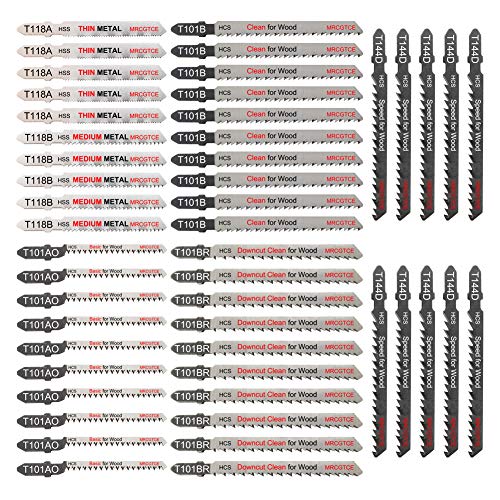 | Best All-Around Bundle | T-Shank: T-shank (assorted) | Laminate-focused cutting: Includes laminate-suitable blades (assorted) | Bi-metal construction: High carbon steel / high speed steel (non-bi-metal stated) | VIEW LATEST PRICE | Read Our Analysis |
| Diablo Bi-Metal Jig Saw Blade Set – 3-14″ Length 14 TPI & 20 TPI 5 Pieces |  | Fast, Clean Laminate Cuts | T-Shank: T-shank | Laminate-focused cutting: Designed for abrasive laminate cutting | Bi-metal construction: Bi-metal | VIEW LATEST PRICE | Read Our Analysis |
| BOSCH T101AOF 5-Piece 20 TPI Jig Saw Blades |  | Best for Straight Laminate | T-Shank: T-shank | Laminate-focused cutting: Specialty for laminate flooring | Bi-metal construction: Bi-metal | VIEW LATEST PRICE | Read Our Analysis |
| Bosch T11C 11 pc. Laminate/Wood/Metal T-Shank Jig Saw Blade Set |  | Pro Multi-Purpose Set | T-Shank: T-shank | Laminate-focused cutting: Includes laminate-cutting blades | Bi-metal construction: Bi-metal (plus carbide tech on one blade) | VIEW LATEST PRICE | Read Our Analysis |
| Bosch TPW005 5 pc. T-Shank Jig Saw Blade Set for Pro-Wood |  | Best for Wood-Laminate Blend | T-Shank: T-shank | Laminate-focused cutting: Includes laminate cutting blade (T101BIF) | Bi-metal construction: Bi-metal / high-carbon steel (stated) | VIEW LATEST PRICE | Read Our Analysis |
More Details on Our Top Picks
Bosch T503 3 pc. Hardwood/Laminate Flooring T-Shank Jig Saw Blade Set
If you’re cutting laminate flooring and want cleaner results with less chipping, the Bosch T503 T-shank jig saw blade set is a solid choice. It’s designed specifically around flooring trim work, so it handles long, straight runs and the kind of shaped cuts you often need around vents, doorways, and wall edges. In real use, the cutting action feels stable and predictable, which matters when you’re trying to keep the laminate’s edges looking crisp instead of ragged.
Usability is one of the set’s strengths. The T-shank format makes it straightforward to swap blades on compatible jigsaws, and the blades are well suited to working from the top side, which is a big deal when your setup makes bottom-side access difficult. That combination of stable tracking and top-side cutting support helps you maintain control, especially when you’re following layout lines or trimming multiple boards to match the room.
As for what to watch out for, blade choice still matters. If you’re also doing hardwood, you’ll likely want to pair this set with a blade intended for cleaner hardwood work, because laminates and hardwoods behave differently under a jigsaw. Even with a flooring-focused blade, you still need to avoid forcing the feed rate, because rushing through laminate is one of the quickest ways to invite edge damage.
The set’s main practical benefit is that it gives flooring installers and DIYers a more refined cutting approach without requiring constant micromanagement of the cut. It’s also a convenient 3-piece bundle for handling mixed straight and curved trim tasks across a jobsite. For most people tackling laminate flooring layouts, including fit-up work around complex boundaries, it’s a dependable way to improve edge quality while keeping the jigsaw experience comfortable and controlled.
- T-Shank:T-shank
- Laminate-focused cutting:Optimized for laminate/hardwood
- Bi-metal construction:Bi-metal
- Set quantity:3 pc.
- Clean cuts claim:Clean straight/laminate cuts
- Tooth-count variants (TPIs):20 TPI
- Additional Feature:T101BF: Clean hardwood
- Additional Feature:T101AOF: Laminate special
- Additional Feature:Fits 90%+ jigsaws
Bosch T128BHM3 3-Piece Carbide Jig Saw Blades
Bosch’s T128BHM3 blades are a strong choice when you’re cutting laminate and similar brittle sheet materials and you need cleaner edges than you’d get from many general-purpose jigsaw blades. The carbide strip approach really shows up in the way the cut holds up under real shop conditions, especially when you’re trying to avoid chipping around the entry and exit points.
In use, they’re straightforward, as long as you feed the jigsaw steadily. If you push too hard, even the best blade can start to stress the material and the line can suffer. With the right pace, the twin-direction tooth pattern helps you stay on track, and the blade’s thin cutting action reduces heat buildup, which matters a lot when you’re working with laminate flooring where overheating can make edges look rough or uneven.
What stands out day to day is how well these blades help maintain edge quality on both sides of the workpiece, which is exactly what you want when the “pretty face” is both top and bottom. If you’ve ever watched cheaper blades chew up laminate, these blades feel built for that specific job, giving you more predictable results when you’re cutting sections that have to fit cleanly against walls, trim, or adjoining panels.
They’re also a practical option for users who might occasionally run into minor hazards like nails in older subfloors, since they’re designed to tolerate a hit without immediate drama. That said, they’re not magic, you still need the right jigsaw setup, stable material support, and proper blade alignment to get the best results. If your work involves tougher brittle surfaces and you want a more controlled, chip-resistant cut, these blades are well matched to the task.
- T-Shank:T-shank
- Laminate-focused cutting:Clean, chip-free laminate cuts
- Bi-metal construction:Carbide strip (set type)
- Set quantity:3 pc.
- Clean cuts claim:Clean, chip-free cuts
- Tooth-count variants (TPIs):14 TPI
- Additional Feature:Carbide-strip construction
- Additional Feature:10x life vs bi-metal
- Additional Feature:Nail-hit tough claim
50-Piece Contractor Jigsaw Blades Set with Case
A 50-piece contractor jigsaw blades set with case is a practical upgrade for anyone doing laminate flooring and trim work. In real use, the value shows up in how quickly you can switch blades to match the material you’re cutting, instead of stopping mid-project to hunt through a loose assortment. The included storage case also helps keep blades organized and easy to grab, which matters on job sites where tools tend to “walk off” when you’re in and out of rooms.
What makes this set useful is its focus on clean, controlled cuts across common flooring tasks. When you’re working with laminate, you generally want the edge quality to stay consistent across the full cut, and having blades intended for curved cuts and double-sided laminate operations helps you manage that. For straighter work, the set supports finer, more controlled approaches that are better suited for keeping top surfaces tidy, especially when you’re trying to avoid breakout, chipping, or ragged edges that can ruin a finished run.
You’ll also find it covers the transition from wood-like materials to metal trim without turning your workflow into a guessing game. Blades designated for metal use make it easier to stay on task with thinner gauges and narrower applications common around flooring edges. Still, the biggest real-world “keep it working” point is that you should match the blade choice to the cut you’re trying to make, because forcing speed with the wrong blade leads to messy results and wasted time.
Where the set can fall short is also where jigsaw setups can be tricky in general: blade fit and condition matter. If a blade isn’t seated correctly in the T-shank adapter system or if you keep pushing dull blades through demanding material, you’ll feel it in the cut quality and control. The case and variety help you stay prepared, but they don’t replace the basics, like checking fit first and swapping when performance starts to slip.
- T-Shank:T-shank (assorted)
- Laminate-focused cutting:Includes laminate-suitable blades (assorted)
- Bi-metal construction:High carbon steel / high speed steel (non-bi-metal stated)
- Set quantity:50 pc.
- Clean cuts claim:Splinter reduction / clean cutting (varies by blade)
- Tooth-count variants (TPIs):6/10/12/21 TPI (varies by blade)
- Additional Feature:50-piece assorted set
- Additional Feature:Includes storage case
- Additional Feature:Mixed wood-metal-plastic use
Diablo Bi-Metal Jig Saw Blade Set – 3-14″ Length 14 TPI & 20 TPI 5 Pieces
Diablo’s DJT505 bi-metal T-shank jig saw blade set is built for people who want cleaner laminate cuts without fighting the tool. In real-world use, the teeth stay consistent through typical straight cuts, and the kerf feels controlled rather than grabby. That translates into a smoother entry and a more predictable line when you’re cutting panels for flooring, wall trim, or finished work where ragged edges are a hassle.
The biggest practical advantage is how readily it handles laminate when you match the blade tooth density to the cut you’re making. With the finer tooth choice, you’ll get a more refined edge, which helps for visible surfaces and “measure twice, cut once” installs. For faster ripping through thicker sections, the coarser option tends to move with less fuss, so you can keep workflow moving instead of babying the cut.
Usability is straightforward as long as you have the right jig saw setup. Because these are T-shank blades, they only work if your saw accepts that style, which is the main limitation if you’re trying to mix blades across different brands or older models. Once installed, the fit is simple enough for routine blade swaps on job sites, and the set format is convenient when you’re running multiple cuts back to back on the same project.
Performance-wise, these blades are designed to reduce the resistance you feel during cutting, which makes a noticeable difference when you’re cutting for extended periods. If you let the blade do the work, you get steadier progress and less tendency to chatter or wander. The one thing to watch is forcing the cut, because even the best blades struggle when you push too hard instead of using firm, consistent guidance.
- T-Shank:T-shank
- Laminate-focused cutting:Designed for abrasive laminate cutting
- Bi-metal construction:Bi-metal
- Set quantity:5 pc.
- Clean cuts claim:Clean, fast cuts (reduced effort)
- Tooth-count variants (TPIs):14 TPI & 20 TPI
- Additional Feature:Up to 5X life claim
- Additional Feature:TPI: 14 and 20 options
- Additional Feature:Fits combo/U-shank
BOSCH T101AOF 5-Piece 20 TPI Jig Saw Blades
If you’re cutting laminate and want cleaner, more controlled results, the BOSCH T101AOF 5-piece jig saw blades are a practical choice. They’re especially helpful when you’re working around scrollwork or other curved cut lines, where laminate can splinter and chip easily if your blade doesn’t manage the material gently.
In real-world use, the tighter tooth pitch makes a noticeable difference on the cut edge, particularly when the panel is cut from above. That matters when you need tidy seams for flooring transitions, cabinet liners, or decorative laminate overlays, because small imperfections can show up fast along visible edges.
The blades are built for durability, using bi-metal construction designed to resist breakage. Bosch also positions them as a faster, longer-lasting option than basic high-carbon blades, but the payoff depends on how you run your saw. If you push the jig saw too hard or run it too quickly, you can still trigger chipping, so matching blade speed to laminate is key.
From a usability standpoint, having a multi-pack set is convenient because you can keep replacements on hand for repeated projects or awkward shapes that demand steadier technique. They fit typical jig saw workflows well, but if your job is mostly thick, rough cutting with no concern for edge quality, you may not get as much value from this “clean-cut” approach.
Warranty support and a money-back window add peace of mind, particularly if you’re using them for a home upgrade where one bad cut can cost time. Overall, these blades are best suited for laminate and similar sheet goods where edge control and predictable cut quality are the priority, as long as you maintain reasonable feed speed to avoid chipping.
- T-Shank:T-shank
- Laminate-focused cutting:Specialty for laminate flooring
- Bi-metal construction:Bi-metal
- Set quantity:5 pc.
- Clean cuts claim:Clean cuts in laminate (cut from above)
- Tooth-count variants (TPIs):20 TPI
- Additional Feature:Scroll/curved laminate cuts
- Additional Feature:Clean-from-above laminate
- Additional Feature:2X faster claim
Bosch T11C 11 pc. Laminate/Wood/Metal T-Shank Jig Saw Blade Set
Bosch’s T11C 11‑pc T‑shank blade set is a practical choice if you regularly cut laminate flooring and want fewer headaches when the job turns into a mix of materials. In real use, the blades do the important thing you need from a jigsaw accessory set: they let you match the cut to the material instead of forcing one blade to handle everything. That matters when you’re working around door jambs, transitions, and detailed edge cuts where clean entry and controlled feed make the difference between “looks fine” and “needs cleanup.”
The T‑shank format is a clear usability win. It’s designed to grip securely in compatible jigsaws, so the blade stays stable while you guide it through sheet goods and layered surfaces. You also get the practical benefit of having multiple blade options on hand, which reduces the downtime of swapping blades mid-project.
Where the set really shows its value is in laminate work, especially with demanding, high‑pressure boards. The T128BHM blade stands out for that application because its construction is meant to last and its tooth action helps keep cuts more controlled and consistent, whether you’re working with tight layouts or longer straight runs. Just don’t treat it like a “more pressure equals faster” tool, let the teeth do the cutting.
The main limitation is the usual one for jigsaw blades, you still have to pick the right blade for the material and thickness you’re cutting. If you reach for the wrong blade, you’ll feel it in the cut quality and effort required. But for contractors and DIYers doing flooring installs or mixed-material trim and finish work, this set is built to be dependable in the moments that most often slow projects down, having a suitable blade ready and performing cleanly without fuss.
- T-Shank:T-shank
- Laminate-focused cutting:Includes laminate-cutting blades
- Bi-metal construction:Bi-metal (plus carbide tech on one blade)
- Set quantity:11 pc.
- Clean cuts claim:Clean cuts on both sides (with T128BHM)
- Tooth-count variants (TPIs):Mixed set (includes T128BHM + others; laminate blade includes T128BHM spec)
- Additional Feature:11 pc multi-blade set
- Additional Feature:Storage case included
- Additional Feature:T128BHM carbide technology
Bosch TPW005 5 pc. T-Shank Jig Saw Blade Set for Pro-Wood
The Bosch TPW005 blade set is built for real-world, clean-cut jigsaw work, especially when you’re dealing with tricky sheet materials like wood laminate where edge chipping can ruin a finish. With five T-shank blades in the pack, you can match the cut to what you’re cutting instead of stopping mid-job to experiment. The standout benefit is how well the blades help you keep edges tidy, because laminate and other surface-sensitive materials demand a more controlled cut than general-purpose blades can consistently deliver.
In practical use, the T101BIF blade is the one that shines when you need cleaner results on laminate, including straight cuts and gentle curves. That matters when you’re fitting cabinet parts, door panels, or decorative overlays where splintering along the top edge is the difference between “installed” and “needs sanding.” For folks who frequently cut exposed edges, the T101AO’s reverse-tooth style is especially useful, since it helps reduce splintering on the surface and leaves a more presentable top side.
Where usability comes into play is blade choice and swapping during a project. The set’s included blade variety covers common woodworking needs, from general wood cutting to cleaner cuts on materials like hardwood and plywood/OSB type sheets. It’s also a good fit for users who want to keep one jig setup running across multiple stages, because the T-shank format is designed to work with compatible jigsaw models without forcing mismatched blade geometry.
That said, this set still expects you to use your jigsaw correctly. If you shove the feed rate or let the base shoe lose stability, even a “clean” blade will struggle and you’ll still see chipping or rough edges. Also, it only makes sense if your jigsaw supports the T-shank blade style, since forcing a blade onto an incompatible system defeats the whole point of having a matched blade lineup for cleaner results.
- T-Shank:T-shank
- Laminate-focused cutting:Includes laminate cutting blade (T101BIF)
- Bi-metal construction:Bi-metal / high-carbon steel (stated)
- Set quantity:5 pc.
- Clean cuts claim:Clean cuts; reduced splintering
- Tooth-count variants (TPIs):Mixed blades (TPIs by blade model, incl. laminate blade T101BIF)
- Additional Feature:Reverse-tooth splinter reduction
- Additional Feature:Laminate blade: T101BIF
- Additional Feature:Includes hardwood T101BF
Factors to Consider When Choosing a Jig Saw Blade for Laminate Flooring
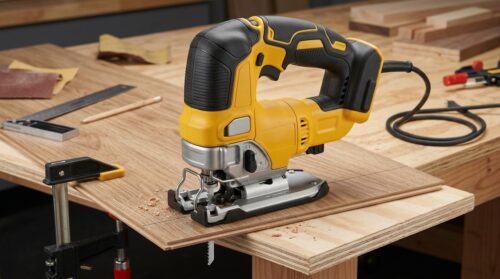
Before you buy anything, we check T-shank compatibility with your jig saw, because if it doesn’t snap in right, you’ll just waste time (and maybe your mood). On the flip side, we match the blade type, carbide vs bi-metal, then pick the tooth count for cleaner laminate, plus plan cut-from-above so chips stay tame. And yeah, we decide early whether we’re doing straight cuts vs curved cuts, because that choice changes the blade geometry, and cutting wrong can leave jagged edges, ASK YOURSELF: are you chasing precision, or are you okay with “close enough”?
T-Shank Compatibility Check
Wondering if your jigsaw blade swap is gonna work out clean? First, we check the shank, because T-shank blades are designed for maximum grip and stability in the holder, and you don’t want wobble mid-cut. On the other hand, don’t assume, confirm T-shank wording on the packaging/specs before we even think about tooth count or material. Next, we verify it fits your exact jigsaw model, and good news: T-shank designs work with over 90% of current makes and models. On the flip side, if you’ve got a U-shank tool, verify adapter or compatible blades, otherwise you’ll be cursing like I did, mid-project. Finally, we make sure the blade’s length/thickness match the saw’s stroke and guide, since T-shank only nails the mount, not the cutting geometry!
Carbide Vs Bi-Metal
When you’re picking a jigsaw blade for laminate, carbide vs bi-metal is one of those decisions that quietly decides whether your cuts look factory-clean or like a chip-and-pray situation. We go carbide when we want maximum longevity; those carbide cutting strips are claimed to last way longer (think “10x life”), and that hard edge is made for brittle, chip-prone material. On the other hand, we choose bi-metal when we want more standard durability plus a bit of flex, since the tougher steel backing survives bumps and nail-hit moments better. However, don’t assume bi-metal is “rough”, we still get clean results by using fine, thin-kerf blades (like 14 TPI or 20 TPI). If you cut a lot, carbide’s our go-to; if it’s mixed work, bi-metal’s safer, PERIOD.
Tooth Count For Cleanliness
To get a cut that looks clean on laminate instead of jagged and ugly, we need to pay attention to tooth count, aka TPI. On higher TPI blades (like 20 TPI), we get finer, cleaner cuts because more teeth remove material gradually, and yeah, your edge looks way less “chewed.” Yet, lower TPI (around 14 TPI) can still cut laminate effectively, it just tends to leave a rougher edge, and it’s more about speed than perfection.
For chip-free results, we like laminate-specific blades with extra-clean tooth arrangements, sometimes counter-directed at angles, then pair that with 14 or 20 TPI for the win. When you compare blades, treat TPI as a cleanliness indicator: 20 TPI leans smoother; 14 TPI trades finish for faster removal. Choose wisely, don’t rush!
Cut From Above Focus
Therefore, we also want higher tooth density, think 14 TPI or 20 TPI, since it smooths the edge and reduces splintering. On the flip side, if you can find reverse-tooth or bi-directional geometry, grab it; it helps sever fibers from the top with less breakout.
- Choose chip-free-from-top marketing claims
- Use top-side clean-cut blades
- Don’t ignore wear, laminate bites blades fast
Straight Versus Curved Cuts
Straight cuts and curved cuts aren’t just different shapes, they’re different “bite” problems for your laminate, and the blade choice has to match. For straight cuts, we reach for laminate-optimized blades with finer tooth counts, like 20 TPI, because fewer chips on the edges matters (I learned that the hard way, staring at a ragged exit side!). Conversely, for curved or gently curving cuts, we swap to blades meant for non-linear paths, still laminate-rated, usually higher-TPI, so the blade tracks clean through tight radii.
On the flip side, if we cut straight from the top, we pick blades explicitly noted for top-down laminate quality, since tooth geometry affects splintering on the exit. Also consider downcut vs reverse-tooth behavior for curves, top-surface cleanliness still counts when you’re exiting. Higher tooth density (20 TPI vs 14 TPI) tightens control, but speed and tracking through corners change too, don’t rush!
Kerf Width Heat Management
Kerf width and heat management are where our jigsaw blade choice starts to make or break that “store-bought edge” look on laminate, because every extra bit of material we shave out has to go somewhere, usually into friction and heat. Thin kerf blades remove less per pass, so we cut cooler, and that helps stop surface melting/chipping. Carbide or laminate-optimized designs usually pair thin kerf with smart tooth geometry, which keeps the cut controlled instead of scorching! On the flip side, tooth spacing matters too, closer teeth like 14 TPI often reduce heat by making cleaner, steadier entry.
If you see burning/melty edges, don’t fight it, swap to a thinner-kerf, better heat-control blade; it’s usually an instant fix.
Chip Reduction Design
Chip reduction is the make-or-break part of picking a jigsaw blade for laminate, because laminate is brittle, and it loves to splinter right where you don’t want it, especially on the entry and exit edges. If you’ve ever seen a perfect cut turn into a jagged mess, you get it. Look for blades designed for chip-free cuts, ideally with counter-directed tooth angles so we’re scoring less on both sides. On the flip side, choose “top-side cutting” designs, since laminate-specific geometry helps keep the visible face clean. Also, go higher tooth density, around 20 TPI, for smoother surfaces, smaller tooth bites, fewer chips. Finally, pick splinter-reducing patterns: reverse-tooth/downcut or top-splinter reduction styles. Don’t cheap out, seriously.
Blade Life And Toughness
Once you’ve dialed in the chip-reduction stuff, the next thing that bites people on laminate is blade life and toughness, because you don’t want to babysit a blade every 10 minutes, especially when you’re cutting sheets all day. On the other hand, laminate’s hard and abrasive, so we prioritize carbide or carbide-brazed edge designs, marketed with up to 10×–10× longer life versus standard bi-metal/high-carbon steel. However, tough cutting edges matter too, like carbide-strip or bi-metal with carbide welding/tech, because they resist rapid wear. Also, don’t ignore jobsite reality, some blades are built to survive a nail hit and keep cutting. We also choose thin kerf and optimized tooth layouts, lower heat and extraction. Higher TPI (20 vs 14) helps, but check real toughness claims, YES, I learned that the hard way.
Frequently Asked Questions
Which Jigsaw Blade TPI Best Reduces Chipping in Laminate Flooring?
We recommend using a 10–12 TPI fine-tooth jigsaw blade (carbide, downcut or laminate-specific). It reduces chipping by cutting cleaner fibers. We also suggest steady speed and masking tape, so you get smooth laminate edges.
Do I Need a T-Shank Blade for All Common Laminate Jigsaws?
You don’t need a T-shank blade for every common laminate jigsaw, only for models that require T-shank. We recommend checking your jigsaw’s blade holder; if it’s T-shank compatible, use one, otherwise match the blade type exactly.
What Blade Type Cuts Laminate Faster: Carbide, Bi-Metal, or Fine-Tooth Steel?
For speed on laminate, we recommend fine-tooth steel only if you want clean edges, but carbide usually cuts fastest and stays sharp. Bi-metal splits the difference, offering decent speed. Choose carbide when you’re prioritizing faster cutting.
Can I Use the Same Blade for Laminate Underlayment and Flooring Planks?
Yes, you can use the same jigsaw blade, but we recommend checking thickness and material. Underlayment often needs a finer blade; flooring planks benefit from a sharper, fine-tooth carbide. We still choose clean-cut blades for fewer chips.
Should Laminate Be Cut With the Finished Side up or Down?
Cut laminate with the finished side up, like painting a canvas. You’ll reduce chipping and keep edges crisp. We recommend marking your line, using masking tape, then guiding the jigsaw steadily for clean results.
Final Takeaways
So, if you want clean laminate cuts in 2027, you’ve gotta match the blade to the job, especially T-shanks and higher TPI for less chipping, and a slower feed rate to avoid blowing out a panel. Fun stat: pros typically get noticeably fewer chips when cutting from the top with a fine-tooth blade. On the flip side, test on scrap first, ALWAYS check fit before you commit.
Final takeaway
Clean laminate cuts come down to the right blade setup and cutting technique, use the correct shank and a fine-tooth, higher-TPI blade, move slower to reduce chip risk, cut from the top when possible, and always test on scrap first to confirm the fit.
What matters most
Choose a blade that matches your jigsaw’s T-shank requirement, prioritize higher TPI/fine teeth to reduce chipping, cut with a slower feed rate, and verify fit by testing on scrap before you cut the real pieces.
Recommendations
- Best Overall: A fine-tooth, higher-TPI T-shank jigsaw blade. It hits the key points the article emphasizes for fewer chips: correct compatibility (T-shank), finer teeth (higher TPI), and cleaner results when you cut from the top.
- Best Budget: A fine-tooth blade with an emphasis on higher TPI. The article’s main cost-sensitive takeaway is that paying attention to tooth fineness and TPI helps reduce chipping, so you get the most practical improvement without adding extra complexity.
- Best for the Money: A T-shank blade designed for laminate use, paired with a slower feed rate and top-side cutting. This option fits the strongest “value” approach from the article by combining compatibility (T-shank) with the two biggest technique factors that reduce damage and chipping: slower feed and cutting from the top.

his personal experience and loves to share their nitty gritty details with his audience.
Although Richard does focus on other home improvement tools, his focus remains on cutting fallen trees or maintaining his backyard via chainsaw tools. He pledges to come up with new knowledge about chainsaws every once in a while.
- 5 Best Ryobi Jigsaws for 2027 - September 29, 2026
- 5 Best Mini Jigsaws for 2027 - September 29, 2026
- 7 Best Lightweight Jig Saws for 2027 - September 29, 2026